
An empty dental chair costs a clinic money every single day: an unused hour can never be recovered. Patients reach a clinic in three ways: through referrals, through aggregators, and through the clinic's own channel, meaning its website, Google Maps listing, and the answers AI assistants give in three languages. The own channel belongs to the clinic and charges no commission, but a steady flow of patient inquiries from it typically takes six to eight months to build.
This article is written for owners and chief physicians of dental clinics with six or more dentists and more than four dental chairs. In our experience, most dental clinics in Tbilisi have hours when the treatment rooms and doctors are ready and willing to work, but patient load is insufficient. Below, we explain how to calculate this idle time, where a clinic gets its patients today, why a clinic website, a Google Maps listing, and ChatGPT answers have become an independent source of appointments, and why dental clinic marketing calls for a professional, specialized approach.
We are Signum Medical Marketing, an agency that works exclusively with medical clinics. Two notes. First: we work under non-disclosure agreements (NDAs), so you will not find examples with clinic names here. Medicine demands discretion and ethics. Second: the calculations are in hours and percentages, not money. Every clinic has its own prices, and you will plug in your own figures.
One more observation from our practice. In Georgia, ChatGPT is already an everyday tool, used by young and older people alike. Patients ask questions in Georgian, Russian, and English: where should I get a dental implant, and how much does it cost? Georgian dentistry is high quality, and prices are generally lower than in Europe. So these questions are not asked only by residents of Tbilisi, Batumi, and Kutaisi. Russian-speaking and English-speaking patients ask them too, including medical tourists. Foreigners want to know whether dental treatment in Georgia is worth it and which clinic exactly to contact.
What an Empty Dental Chair Costs and How to Calculate It in 10 Minutes
The cost of an empty chair is the amount a clinic would have earned during the hours it sat idle. Based on our work with clinics, average chair utilization ranges from 45% to 75%. In other words, anywhere from a quarter to more than half of chair working time goes unused.
The chair-hour: a metric every owner knows
A chair-hour is one hour during which a chair is ready to receive a patient. Rent, equipment, salaries, and guaranteed doctor pay are paid whether or not a patient is sitting in the chair. An idle hour never comes back. That is why it is more useful for an owner to track chair utilization than the total number of patients seen in a month.
The 10-minute calculation formula
Multiply the number of chairs by working hours per day and by working days per month. This gives you chair-hours per month.
Determine your utilization: how many chair-hours are actually occupied by patients. The rest are free.
Multiply the free chair-hours by your clinic's average revenue per chair-hour. That is the amount the clinic failed to earn.
Take five chairs, a ten-hour working day, and 26 working days. That is 1,300 chair-hours per month. The example is hypothetical; plug in your own numbers.
Utilization | Free chair-hours per month |
45% | 715 |
60% | 520 |
75% | 325 |
In this example, every ten percentage points of utilization equals 130 chair-hours per month. Multiply that number by your revenue per chair-hour, and you will see what those ten points are worth to your clinic specifically.
Why a chair sits empty even in a busy clinic
Idle time is not always explained by a shortage of patients. In a February 2022 poll by the American ADA Health Policy Institute, 85% of dentists with incomplete schedules named patient cancellations as the most common cause. These are US figures, but the mechanism is the same: a cancelled or missed appointment leaves the chair empty. An administrator, reminders, and proper schedule management solve this problem. Marketing cannot fix this part, and we do not promise otherwise.
The second part of idle time is related to demand: in the same poll, 43% of dentists cited this reason. No comparable data exists for Georgia, so we rely on our own experience: utilization of 45–75%.
Dental chair revenue can be increased in two ways: by filling more hours, or by raising the revenue from each hour. Every clinic knows which service generates the highest revenue per chair-hour. If patients seeking that kind of treatment find the clinic on their own, the chairs fill more profitably.
Where Patients Come From and What You Control
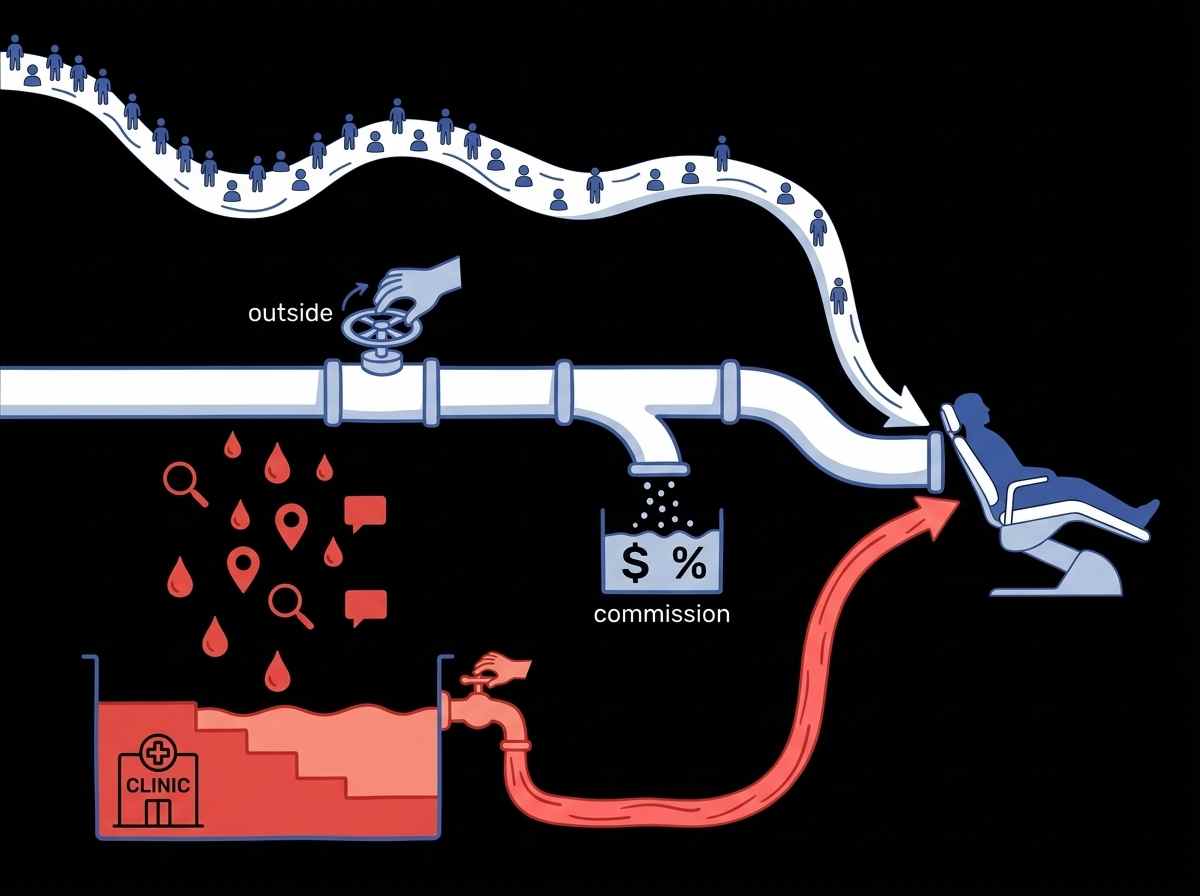
Patient acquisition channels for a dental clinic
A dental clinic has three sources of patients: referrals, aggregators, and its own channel. Referrals are cheap, but they cannot be managed. An aggregator can be managed, but it takes a commission on every patient. The own channel takes longer to build, but it stays with the clinic and works in all three languages.
Referrals: the cheapest and least controllable channel
Referrals from satisfied patients remain the main source of new patients, although their share is shrinking. In the 2026 MouthWatch survey (448 dental practices, USA), 65.6% of practices named referrals as their main source of new patients, down from 77.5% the year before. Google, meaning Google Business Profile (15.6%) and Google Ads (7.6%) combined, accounted for 23.2%. The authors of the review note that Google is closing this gap quickly. Our own experience working with dental clinics in Tbilisi and other Georgian cities confirms this.
You cannot switch referrals on on Monday or off on Friday. Their volume depends on how many patients you have already treated and how satisfied they are, not on an owner's decision.
Aggregators: a rented channel
An aggregator, or intermediary platform such as Bookimed, can bring you patients quickly. According to our data, the price of that speed is 15–25% of every patient's payment. It is like renting office space: you pay for as long as you use it, and the landlord sets the terms. If the commission or the ranking algorithm changes, the flow of patients changes with it, without any involvement from the clinic. In fairness, intermediary platforms do not always deliver on their promises.
Aggregators set their own clinic ranking criteria. Bookimed lists demand, patient ratings, how regularly services and prices are updated, response speed, and certifications. Almost every clinic can build nearly all of these signals on its own website as well, and in doing so gain an independent, manageable, commission-free channel for attracting patients.
We do not recommend abandoning aggregators. A sharp exit is risky and unnecessary. The task is different: build your own channel alongside them and gradually shift the proportion in favor of the clinic's own website.
The own channel: a dental clinic website, Google Maps, and ChatGPT answers
The own channel consists of the clinic's website, its Google Maps listing, and the information AI assistants use in their answers about the clinic, first of all in ChatGPT. It does not work immediately. In our practice, the first technical improvements are visible in the first month, organic traffic growth begins in months three to four, and a steady flow of inquiries forms by months six to eight. Timelines depend on the starting condition of the website, competition in the niche, and the size of the clinic. Sometimes building a new website is more justified than fixing an old landing page: for example, when the site loads slowly on mobile, its structure does not allow adding new pages, or fixing technical errors would cost more time and money than building a new site. A website audit shows which case applies.
The main advantage of investing in a professional website of your own is that this channel is cumulative. Doctor pages, articles, reviews, and a well-thought-out structure strengthen the site's search positions over time. The website's technical foundation (a sitemap, robots.txt, and structured data via Schema.org) also helps search engines process and understand pages correctly. However, according to Google's documentation, a sitemap does not guarantee that pages will be crawled and indexed, and structured data does not guarantee rich results. Technical setup alone produces no results: it needs high-quality, trustworthy content.
Referrals | Aggregator | Own channel | |
Who controls the flow | Patients | The platform | The clinic |
How the clinic pays | No direct payment | Commission on each patient | Monthly work on the website and content |
Launch speed | Cannot be launched at will | Fast | Months |
What remains if you stop | Depends on satisfied patients | The flow stops | The website, reviews, and texts remain |
Patient languages | Your patients' languages | The platform's languages | Georgian, Russian, English, at the clinic's choice |
What Google, Maps, and ChatGPT Say About Your Clinic Today
A patient does not see a clinic as it really is. They see it as the website, the Google Maps listing, the reviews, and the AI assistant's answer describe it. If these sources are empty, contradict each other, or are out of date, the clinic looks weaker than it actually is. You can check this in 10 minutes. This information matters both to patients and to search engines, and presenting it correctly on your website makes it easier for them to understand.
The rater8 Patient Choice Report 2026 (USA, 992 adults surveyed in April 2026) shows the direction things are moving. Among patients who looked for a doctor during the year, the choice was influenced by AI tools (36%), Google search (34%), and doctor recommendations (32%). These are US figures, but the direction matches what we see in Georgia: choosing a clinic increasingly starts with a question to GPT, Gemini, or Claude.ai.
Patients of a Tbilisi dental clinic turn to Google and AI in three languages: Georgian, Russian, and English. This is especially true of medical tourists. A patient from another country cannot walk into the clinic and look around. They judge a clinic by its website, its doctors, its reviews, and the clarity of its terms. If the website has no pages in their language, AI assistants also have less material to draw on when answering a question asked in that language.
The 10-minute test: three questions to ChatGPT about your clinic
Open ChatGPT in a new chat with no conversation history and ask three questions. Repeat them in Georgian, Russian, and English, using a new chat for each language.
"Which dental clinic in Tbilisi is best for dental implants?" (For Batumi or Kutaisi, insert your city.)
"What information is there about the dental clinic [your clinic name]?"
"How much does a dental implant cost in Tbilisi, and is dental treatment in Georgia worth it?"
AI answers differ even for the same question, so ask each question two or three times. Save the answers and the date of the check.
What you see in the answer | What it means |
The clinic is not named in any answer | The AI could not find enough consistent information about your clinic |
The clinic is named, but the address, working hours, prices, or doctors are wrong | Data about the clinic online is contradictory or outdated |
It names aggregators or other clinics | That is where patient attention is going today |
The English answer is more detailed than the Georgian one (or vice versa) | The website's language versions are developed unevenly |
Next, open the clinic's listing in Google Maps. Check the name, address, phone number, working hours, list of services, photos, the number and recency of reviews, and whether the clinic responds to reviews.
Why AI gets clinic details wrong
An AI assistant collects information about a clinic from different sources: the website, the Maps listing, directories, aggregator pages, and reviews. If the information differs between these sources, the AI picks one version or mixes them.
Typical causes of inconsistency:
the clinic's name is spelled differently in Georgian, Russian, and English, and doctors' surnames are transliterated in several variants;
the address or phone number has changed, but old data remains in some directories;
prices on the clinic's aggregator listings were last updated several years ago;
the website has no doctor or service pages that AI can rely on;
the website lacks the technical foundation that helps search engines process pages correctly: the sitemap and robots.txt contain errors, structured data (Schema.org) has not been added, and metadata is incomplete;
the website's structure and content do not show the trust signals Google looks for on medical topics. In Google's quality rater guidelines, such topics are called YMYL (Your Money or Your Life: topics that can affect a person's health, finances, or safety), and the trust criteria are called E-E-A-T (Experience, Expertise, Authoritativeness, Trustworthiness).
According to a review of the rater8 report, AI tools repeat inconsistencies that already exist in directories, listings, and review platforms. That is why consistent data across these sources matters.
What you can check yourself, without contacting us
The solution is called a unified data card. NAP (Name, Address, Phone) means the clinic's name, address, and phone number, which must be identical everywhere: on the website, in Google Maps, on Facebook, in directories, and on the aggregator page. For a trilingual clinic, add a consistent spelling of the clinic's and doctors' names in each language.
An honest note. The sources ChatGPT relies on change constantly, and public data does not confirm that it reads a Google Business Profile listing directly. There is also no publicly confirmed rule that a specific markup is required to appear in an AI answer. Local recommendations rely on websites, directories, and review platforms. The Maps listing matters directly for Google Maps itself. That is why we do not promise that ChatGPT will mention your clinic in any particular answer. What we do is make the information about your clinic complete, consistent, and confirmed by several sources. This raises the likelihood that an AI assistant will rely on correct data, and it does not require deep digital marketing knowledge from you.
What patients and AI read in your reviews
Reviews act as a filter. In rater8's 2026 survey, three out of four patients refuse to book with a doctor rated below four stars, and responses to reviews have become the fastest-growing trust factor. Patients increasingly read short AI-generated summaries instead of the reviews themselves. So the number and recency of reviews matter, and so does how the clinic responds to them.
A few practical rules:
ask real patients for a review after their visit, and never offer compensation for a positive rating;
ask foreign patients to write their review in their own language, and Georgian-speaking patients in Georgian;
reply to reviews without any details of diagnosis or treatment: medical confidentiality applies to public replies too;
reply to a negative review calmly and offer to continue the conversation in a private channel.
Why This Is Not Solved by a One-Off Project or In-House Effort
Because this is not one project but eight interrelated tasks, each with its own rhythm and its own owner. Building a website can take just one or two months, but search positions, reviews, and mentions of the clinic on other sources accumulate over months, and maintaining them takes ongoing work.
Eight elements of one system
Element | What it means | What it needs from the clinic | How often |
1. Website technical foundation | Speed, mobile version, indexing, Schema.org, sitemap, robots.txt | Access credentials | At launch, then as needed |
2. Three language versions | Separate editorial work for the Georgian, Russian, and English versions, with correct language tags | Agreement on terminology | At launch and with every update |
3. Doctor pages | Qualifications, specialization, experience, publications, certificates | Doctors' data and photos | Once, then updates |
4. Expert content | Articles we write, which a doctor reads and signs | One to two hours of doctors' time per month | Monthly |
5. Google Maps and reviews | A fully completed, professionally managed listing, a review collection process, replies | Administrator | Ongoing |
6. Unified data card | The same name, address, phone, working hours, and services everywhere | Confirmation of data | Periodically |
7. External authority | Publications and mentions on third-party platforms | Approval of materials | Monthly, per plan |
8. Measuring and checking AI answers | GA4, events (call, WhatsApp, form), regular checks of a question set in three languages | Access to analytics | Monthly |
We connect WhatsApp to the website of every clinic we work with: for patients from other countries, it is often more convenient to start a conversation in a messenger than to make a phone call. Inquiries from messengers are counted the same way as calls and forms, so the report shows which channel the patient came through.
Google classifies health-related pages as YMYL (Your Money or Your Life) and applies stricter requirements to their authors, sources, and transparency. That is why, on a medical website, all eight elements get separate attention for expertise and trustworthiness (E-E-A-T: Experience, Expertise, Authoritativeness, Trustworthiness).
What stays the clinic's responsibility
In our practice, doctors need one to two hours per month to approve texts. We handle the rest ourselves: we write, optimize, publish, and track results.
Some things stay with the clinic, because we cannot do them in its place:
responding quickly to inquiries and calls;
reminding patients about their appointments to reduce no-shows;
replying to reviews using agreed templates.
We bring you the inquiry. It is the clinic's administrator who turns it into a booked appointment and a patient seen. If inquiries get lost at this stage, marketing cannot make up the loss.
Even a dentist does not treat their own teeth
A doctor who needs treatment goes to a colleague. It is not about qualifications: a colleague can assess the situation from the outside, calmly and professionally. Clinic marketing works the same way. The owner sees the website from the inside; the patient sees it from the outside. The owner knows the clinic has good doctors. The patient knows only what the website, the listing, and the AI answer show.
A good in-house marketer successfully handles social media, advertising, and daily content. The technical requirements of medical websites, multilingual structure, Schema.org, and checking whether the clinic appears in AI answers go beyond their usual tasks. The same applies to a website that was built once and left unchanged: it goes out of date quickly. Outdated prices, doctor lists, and contact details reduce patient trust, and that is reflected in search results as well. A website's information must be updated regularly and integrated correctly by professionals.
How the First Six to Eight Months of Work Unfold
The first technical changes are visible in the first month, organic traffic growth usually begins in months three to four, and a steady flow of inquiries forms by months six to eight. These are guidelines only. Timelines depend on the starting condition of the website, competition in the niche, and the size of the clinic.
Period | What is done | What you see | What we do not promise |
Month 1 | Website diagnostics, fixing technical errors, completing the Maps listing, doctor pages, unified data card, setting up GA4 and events (call, WhatsApp, form). Building a new website if needed | Fixed errors, a faster website, a completed listing, a baseline report | An increase in patient numbers |
Months 2–3 | Doctor-signed articles in several languages, a review collection process, first external publications, a first measurement of the clinic's presence in AI answers | Pages in Google's index, first impressions for target queries | Specific positions in search results |
Months 3–4 | Regular content publishing, review management, adjustments based on analytics | Organic traffic growth, first inquiries from the website and Maps | A specific number of inquiries |
Months 6–8 | Maintaining momentum, expanding topics and languages, repeated measurement of AI answers | A steady flow of inquiries from the own channel, with the own-channel share shown in the report next to the aggregator | A first-place ranking in Google, a mention in a specific ChatGPT answer, or a specific share of inquiries |
We measure results in inquiries, not impressions: how many people called, wrote on WhatsApp, or left a request, from which language, and for which service. The scope and composition of work depend on the package chosen. The three Medical SEO Pack options differ in the number of articles, languages, and external publications.
How to Choose a Dental Marketing Provider: Five Questions for Any Contractor
A good provider answers these five questions directly, without generic phrases. Ask them of any agency or specialist, including us.
1. Do you work in medicine on an ongoing basis, and how is a medical website different from an ordinary one?
A good answer mentions YMYL, doctor pages, doctor sign-off, and sources.
2. Whose accounts will Search Console, Analytics, and the Google listing be under, and what will I take with me if the contract ends?
A good answer: everything is under the clinic's accounts, and all materials are handed over to you.
3. Who writes the texts, who checks the medical content, and how much time will our doctors need?
A good answer: a doctor approves and signs the text; AI is only a preparation tool and does not replace review; each language version is prepared separately.
4. What exactly will the report include?
A good answer: calls, WhatsApp inquiries, and forms broken down by source, language, and service, plus an honest statement of what the provider cannot control.
5. What do you not promise?
A good answer: no first place in a few weeks, no guaranteed percentage of growth, and no call to abandon aggregators abruptly.
How We Answer These Questions
We work only with medical clinics. Every website we build typically has three language versions, doctor pages, Schema.org markup, properly configured GA4 analytics, and WhatsApp, with Google's heightened trust requirements for medical topics taken into account. The articles on the website are written by our editorial team; a clinic doctor reads and signs them. The contents and prices of our three packages and of individual marketing services are published on our website. Before work begins, we run a free express website audit within 24 hours. All our projects are carried out under a non-disclosure agreement (NDA).
When We Are Not the Right Fit
At our agency, advertising is a supporting tool within a strategy, not a standalone product. If you need a flow of patients through paid ads over the next few weeks only, that is a different kind of work, and we do not offer it. We are also not the right fit if you expect a guaranteed position in Google or ChatGPT: honestly, nobody can work that way. And if your doctors cannot spare one to two hours a month to approve texts, doctor-signed content is impossible.
Frequently Asked Questions
How long does it take for a dental clinic's own channel to start bringing in patients?
In our practice, the first technical improvements are visible in the first month, organic traffic growth begins in months three to four, and a steady flow of inquiries forms by months six to eight. Timelines depend on the website's condition, competition, and the size of the clinic.
Should I give up aggregators?
No. A sharp exit is risky and unnecessary. It is better to build your own channel alongside them and gradually shift the proportion in favor of the clinic's website.
Can marketing fully solve the problem of empty chairs?
No. Appointment cancellations and no-shows are a matter of administrator work, reminders, and schedule management. Marketing solves the demand part: it brings the inquiry, and the clinic's administrator turns it into a booked appointment and a patient seen.
Will ChatGPT definitely name my clinic?
No, nobody can promise that. What we can do is make the information about your clinic complete, consistent, and confirmed by several sources. This raises the likelihood that an AI assistant will rely on correct data.
What to Do This Week
Calculate your free chair-hours using the formula at the beginning of this article.
Ask ChatGPT the three questions in three languages and save the answers.
Compare the name, address, phone number, and working hours in your Google Maps listing with those on your website and in directories.
If you are not satisfied with the result, we will show you why it happens and what needs to be done.
Find out why your clinic's website is not bringing in patients: see all our services and order a free express audit within 24 hours, with no obligation.
Find out which format suits your clinic: Medical SEO Pack, three packages for clinics of different sizes.
Read Also
Why Georgian Clinics Lose to Aggregators in Google, and How to Change That
Medical SEO Pack by Signum: Patients from Google and GPT, Directly
Professional Medical Marketing: A Catalyst for a New Stage of Georgian Medicine
Sources and Limitations
Data on sources of new patients and on the influence of AI on doctor choice come from American studies. They show the direction of change, but they cannot replace data from Georgia. The chair utilization range (45–75%), the estimate of aggregator commissions (15–25%), the timelines to a steady flow of inquiries, and the observations about ChatGPT use in Georgia are based on Signum's experience and not on independent research. This material is not legal advice. The article will be updated as new data appears.
Sources:
Signum Medical Marketing on Facebook